Samsung's Chip Profit Jumps Ninefold Yet Still Falls Short of Wall Street's AI-Fueled Expectations
Record quarterly operating profit of 107.4 trillion won was overshadowed by a net-income miss and mobile division losses, even as surging HBM4 memory demand points to a chip shortage running through 2027.
2-MIN READ
By Principle Post Staff·Published
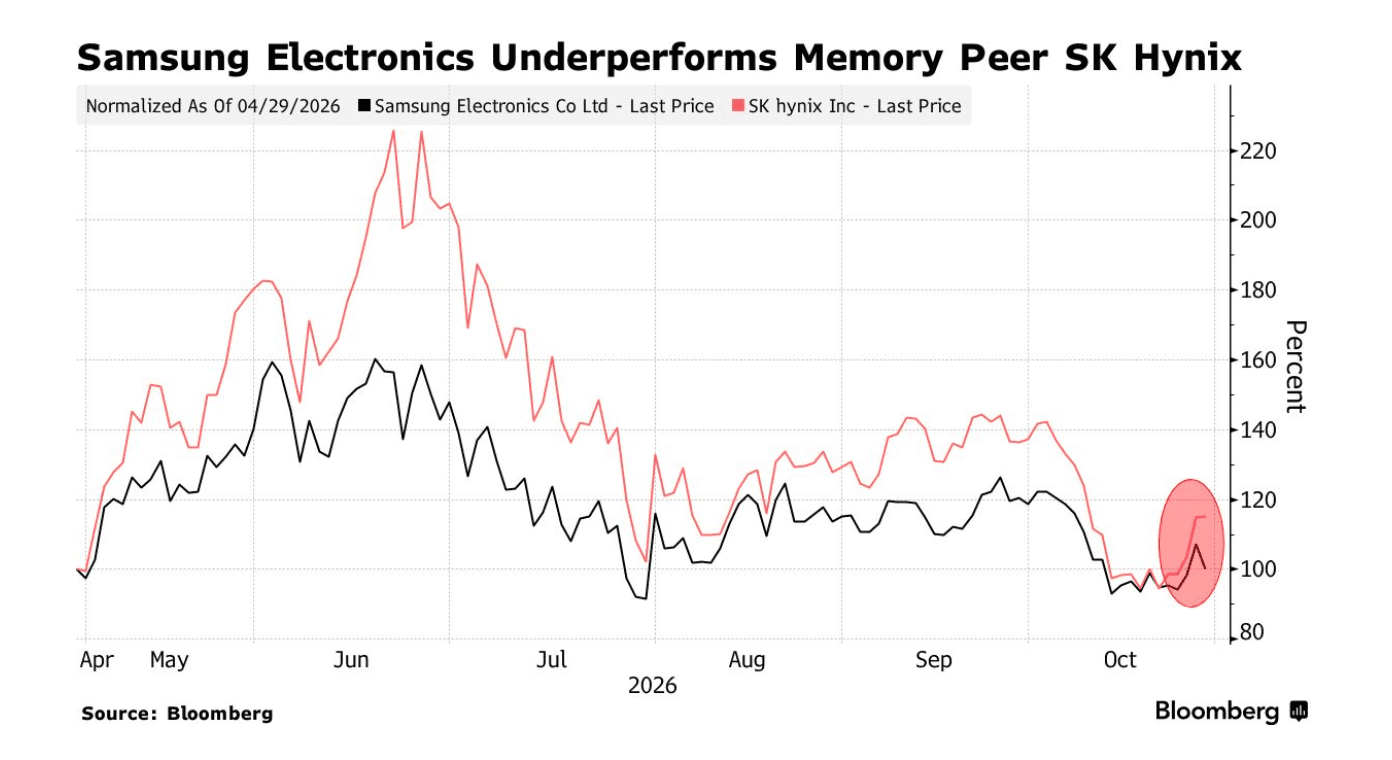
Bloomberg chart comparing Samsung Electronics and SK Hynix share performance · Source: Bloomberg
Samsung Electronics reported record third-quarter results on October 29, with revenue up 127% year-over-year to 195.3 trillion won and operating profit soaring 783% to 107.4 trillion won. Memory chip revenue alone jumped 427% to 140.7 trillion won, driven by booming sales of high-bandwidth HBM4 memory and enterprise SSDs tied to the AI buildout. HBM4, the newest generation of high-bandwidth memory, sits directly alongside AI accelerator chips inside data center servers, and demand for it has outstripped Samsung's ability to supply it for several consecutive quarters now.
Shares fall despite the headline numbers
Even so, net profit of 75.1 trillion won came in below the roughly 89 trillion won analysts had expected, weighed down by losses in Samsung's mobile and consumer electronics division, which fell about 800 billion won into the red as component costs rose. The same memory shortage fueling Samsung's chip division's record quarter is squeezing its phone and appliance businesses from the other side, since those units now have to pay sharply higher prices for the same memory chips the company's own semiconductor arm is selling at a premium elsewhere. Shares dropped roughly 6% in Seoul trading as investors focused on the miss rather than the historic top-line growth.
Still playing catch-up to SK Hynix
Samsung's stock has lagged memory rival SK Hynix for much of the year, a gap that reflects SK Hynix's earlier and deeper push into HBM supply contracts with Nvidia, the dominant buyer of AI accelerator chips. Samsung has been working to close that qualification gap through 2026, and this quarter's HBM4 revenue surge is the clearest evidence yet that it is gaining ground, even if the stock has not yet fully re-rated to reflect it.
Samsung said it expects the global memory shortage to persist through 2027 and potentially into 2028, and plans to lift capital expenditure to 84.4 trillion won this year to keep pace with AI-driven demand. For a stock that has lagged memory rival SK Hynix for much of the year, the message to investors is that the current squeeze on profitability is the price of chasing a shortage, not a sign of slowing demand.